
AI firm Bombe predicted the Reform UK and Green Party surge
AI firm Bombe predicted the surge in support for Reform UK and the Green Party in English local elections
An AI-driven model was the first to predict the Reform UK surge across England that saw Nigel Farage's party seize control of an additional 14 councils and gain almost 1,500 more councillors.
Data firm Bombe, the UK's leading audience insight platform, used machine learning to forecast the local election results two months before millions of voters went to the polls last Thursday.
The results highlight Bombe's ability to use demographics and real-world data rather than traditional opinion polls to predict surges in political support.
Its model correctly forecast that Reform and the Green party, despite being at opposite ends of the political spectrum, would both make big gains from Sir Keir Starmer's Labour party.
Reform gained 1,451 council seats and won control of councils such as Havering in east London, Sandwell and Walsall in the West Midlands and Gateshead, Sunderland and South Tyneside in the North-East.
Bombe had predicted in March, as first reported in the Daily Mail, that Reform could pick up more than 1,500 seats and control of 17 more English councils.
In an update 10 days before polling day, it refined its prediction to say that Reform would gain control of 14 councils - which is exactly what happened.
The Green Party was the other big winner last week, claiming victory for the first time in three London councils - Waltham Forest, Hackney and Lewisham.
All three boroughs had been earmarked by Bombe as ripe for a Green takeover due to its unrivalled understanding of each borough's demographics and the expected behaviour of voters, down to ward level.
Bombe correctly predicted that Labour would lose control of Brent and Haringey due to a Green surge, and that the Tories would do better than expected in Bexley and Bromley, holding off Reform to retain control in both boroughs.
Bombe also said that Labour would lose control of Birmingham City Council and that support would splinter between multiple parties, with Reform a dominant minority and the Greens outperforming expectations - all of which happened.
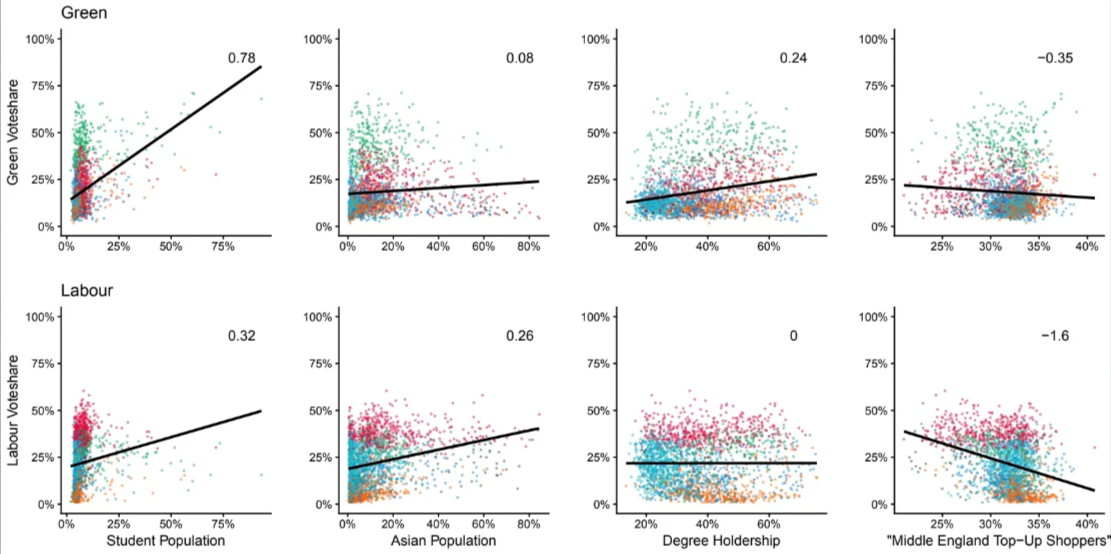 "Graph showing the Green vote rising sharply with student population - Labour's line moves modestly on the same measure. Labour lost most heavily in Middle England suburban areas, more so than the Greens."
Mike Joslin, co-founder and CEO of Bombe, said: "Our pioneering machine learning technology looks at real-world behaviour rather than relying solely on opinion polls, and the results of this election validate that approach. The data told us months ago that both Reform and the Greens were building concentrated momentum in very specific communities - and that is exactly what happened.
"The fragmentation of the Labour vote between two insurgent parties pulling in completely opposite directions is precisely the kind of trend our machine learning is built to identify early."
Across England, Labour ended the weekend with 1,496 fewer councillors and 38 fewer councils under its control.
Bombe got its predictions right by dividing the population into nine demographic and seven commercial groups (or "personas") on a ward-by-ward basis - using "real world" behaviour over the last four years to inform its analysis.
This differs to traditional polling, which typically uses survey responses from 1,000 or more people to estimate how the wider electorate will vote.
The Bombe model found differences between Tory and Reform voters. Tory voters were more likely to be Remainers, wealthier and to have degrees. Reform voters were more likely to be Leavers, UK-born white people, poorer, older and not hold a degree.
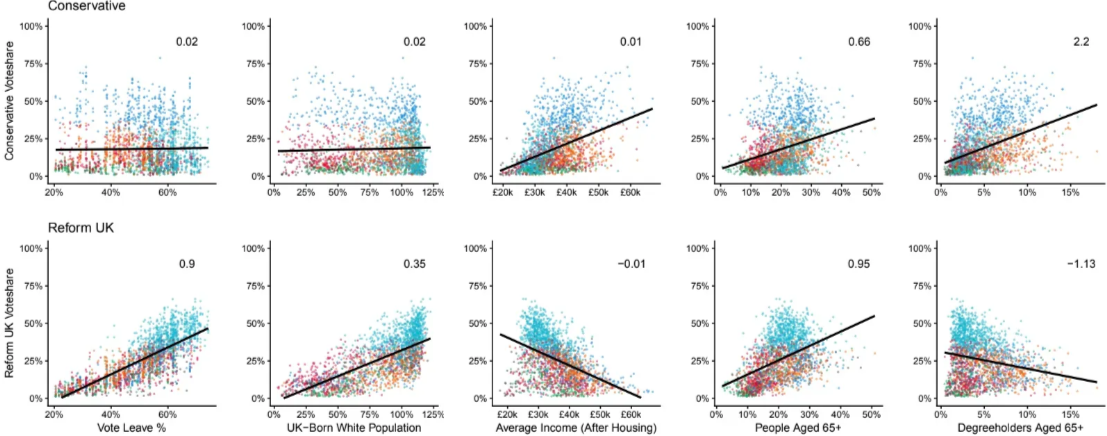 "Graph comparing Reform and Conservatives on a range of key metrics including: Vote Leave %, UK Born White Population, Average Income (after housing), People Aged 65+ and Degreeholders Aged 65+"
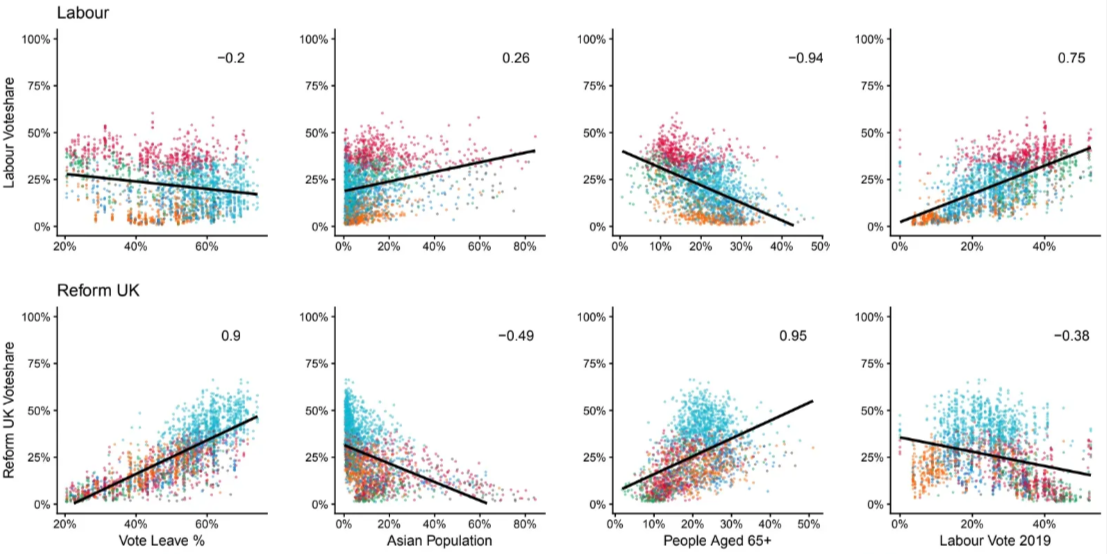 "Graph comparing Reform and Labour on a range of key metrics including: Vote Leave %, Asian Population, People Aged 65+ and Labour Vote Share in 2019"
Bombe established early on that Reform and the Greens would perform like "political insurgents", with their votes concentrating in different parts of the country.
In general, Reform performed best outside of London while the Greens performed best in inner London. The Greens also ended up as the largest party in Lambeth and Haringey, resulting in Labour losing control of both London boroughs.
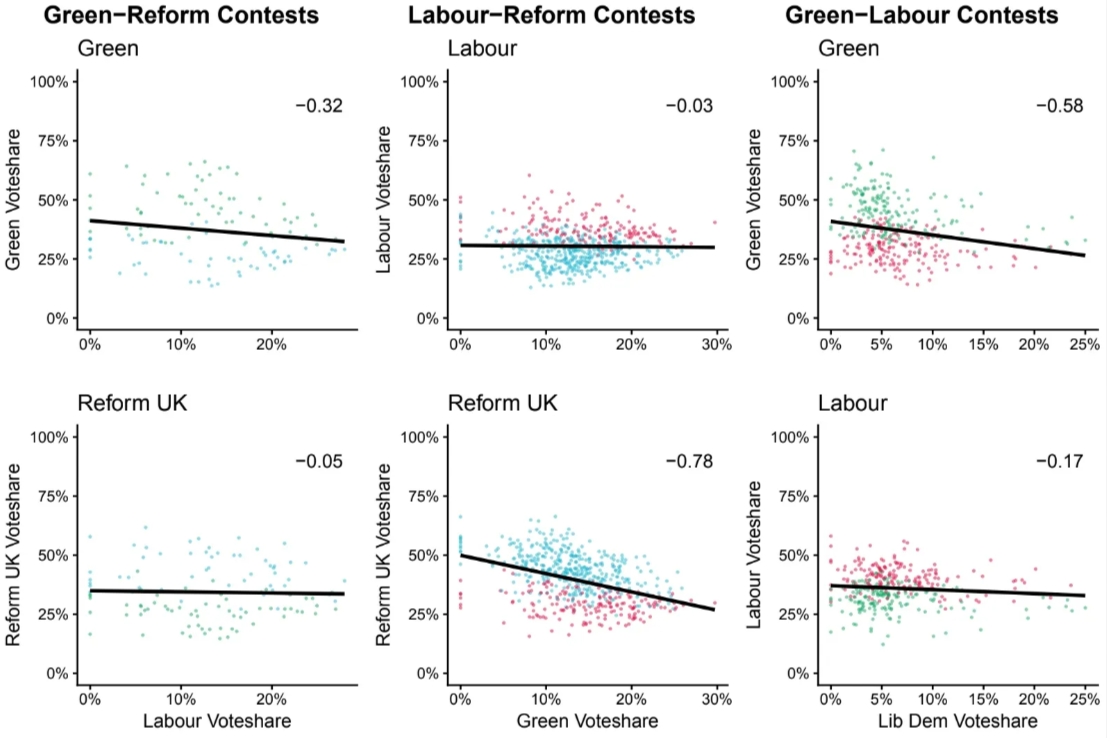 "Graph comparing how Reform, Labour and the Greens traded votes against each other in directly contested wards"
Bombe's post-election analysis found that Labour had a higher vote share among "high demanding, high income" voters than the Greens.
These are older millennials and early Gen X, typically people in their 30s to 50s who are high earners who spend freely but are not easily impressed.
 "Graph showing the Green vote across a range of commercial consumer groups"
Bombe found that Reform was far more likely than the Greens to attract the lowest-paid earners and "steady strivers", people over 40 who have worked in the same (or a similar) average-wage job all their life.
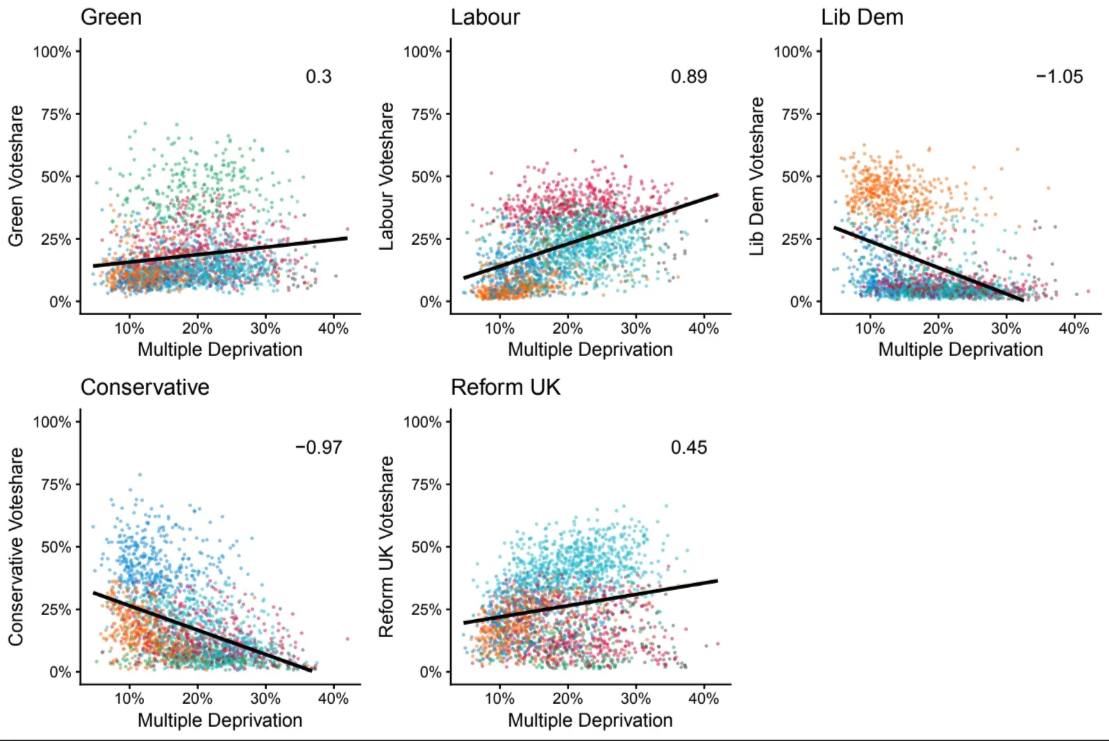 "Graph comparing all five parties against the Multiple Deprivation index, showing how each party's vote share rises or falls as deprivation increases"
Reform did best among skilled manual workers, while Labour did poorly, Bombe established - despite the Prime Minister's frequent narrative that his father was a tool-maker.
The Greens polled highest among urban dwellers (people who live in cities and are likely to have liberal values), career starters (young people in education or their first job) and the student population.
Aspirational renters - people in their 30s who want to get on the property ladder - turned to Reform far more readily than Labour or the Greens.
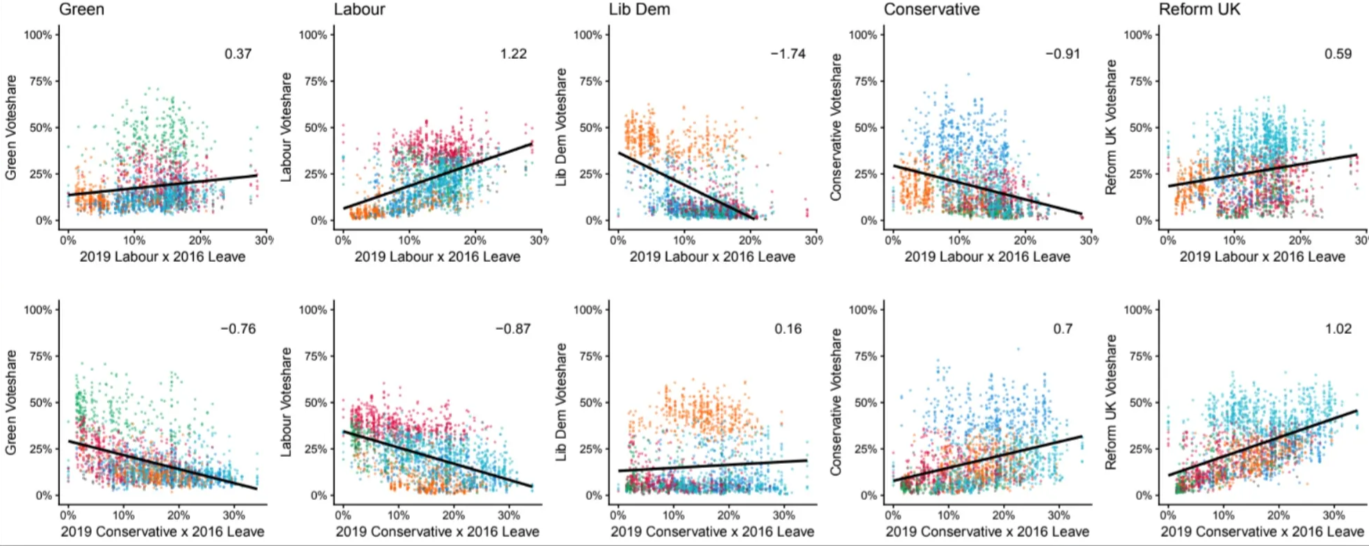 "Graph comparing all five parties in wards that voted Labour-Leave and Conservative-Leave in 2019, showing how the Brexit vote shaped the 2026 result"
On Manchester City Council, the Green surge was predicted, though Labour held control as only a third of seats were up for grabs.
In the North-West, Bombe called the Reform victory surge in St Helens, which it gained from Labour.
Similarly in Yorkshire, it foresaw Reform victories in the former Labour territories of Calderdale, Wakefield and Barnsley.
The Green vote was highly concentrated in inner city areas, where Zack Polanski's party gained from Labour - a major strategic problem for Labour.
Reform and the Greens both won votes from "aspirational renters" who want to own their own home. The Greens also picked up votes from "urban dwellers" (people who live city lives). Reform won support from "low-paid workers".
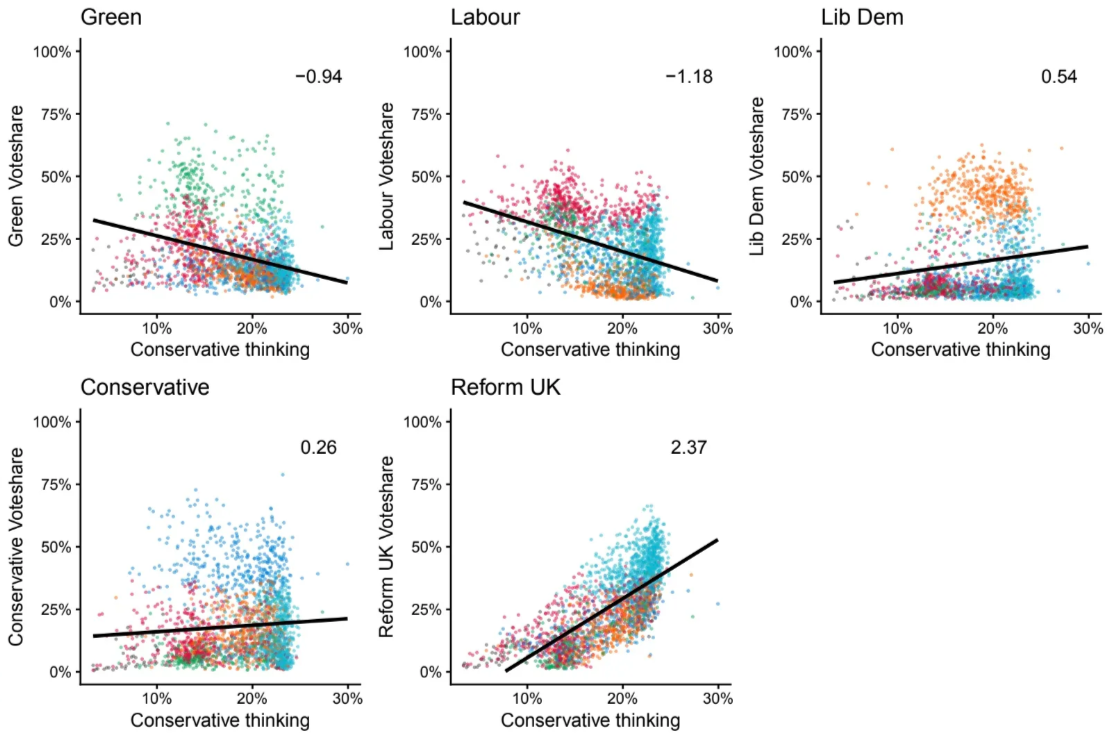 "Graph comparing all five parties against the "Conservative Thinking" consumer group, showing how this commercial persona predicted vote share across the political spectrum"
A total of 136 councils held elections last Thursday, 63 of them for the full council and 73 where part of the council chamber was up for re-election.
In Manchester, the Greens won most seats as predicted (but were unable to seize control of the council as only a third of seats were up for grabs).
Prior to the local elections, Bombe's pioneering "results based modelling" technique had accurately predicted the results of 17 out of the last 20 by-election results, including the Green party victory in Gorton and Denton in February.
For more information or further comment, please contact: George.Stenner@bombe.io
About Bombe
In 2002, the Oakland Athletics baseball team, in an approach dubbed "Moneyball" in the book and Hollywood film, used machine learning to work out why they were winning or losing games.
Bombe was founded to pioneer result-based prediction in consumer insight, something nobody else has done until now.
Bombe has created a model of the UK that works out what motivates people to do things like vote and buy things.
Bombe's personas are based on what drives people to behave in certain ways.
Using machine learning, this is predicted down to postcode level. This is augmented with transport data, weather data, company data and much more.
Bombe's models can accurately predict things like supermarket sales, street level store sales, online sales by postcode, social issues and elections.
Want to learn more about Bombe?
See how Bombe helps brands understand their customers with AI-powered market research.
Request a demo